
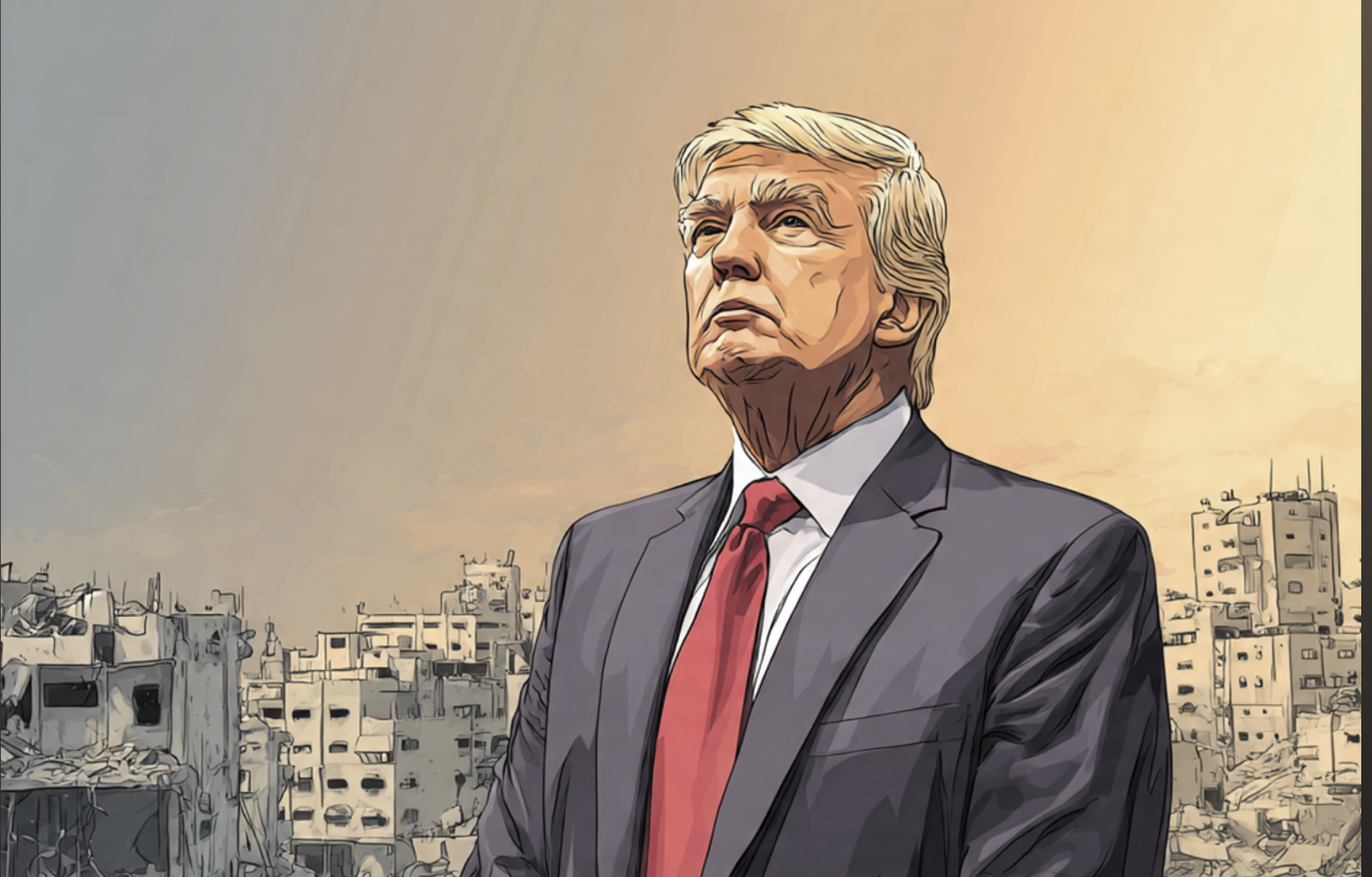
Trump’s Proposal for Gaza
President Donald Trump’s proposal for Gaza, announced on September 29, 2025, during a joint press conference with Israeli Prime Minister Benjamin Netanyahu at the White House, is a comprehensive plan aimed at ending the ongoing Israel-Hamas war. It builds on earlier ideas from Trump’s February 2025 statements about U.S. administrative control and redevelopment but has evolved into a more diplomatic framework emphasizing deradicalization, reconstruction, and international oversight. The plan requires immediate acceptance by both sides for a ceasefire, with Trump warning that Hamas has “three or four days” to respond, or face consequences including full U.S. support for Israel to “finish the job.”
Netanyahu has endorsed it, but Hamas has not yet formally responded, stating it is “studying” the proposal in good faith while expressing skepticism.
Key elements include:
Immediate Ceasefire and Hostage Release:
The war ends upon agreement, with all remaining hostages (living and deceased) released within 72 hours. In exchange, Israel releases 250 Palestinian prisoners serving life sentences, 1,700 Gazans detained post-October 7, 2023, and the remains of 15 deceased Palestinians for each Israeli hostage’s remains.
Deradicalization and Demilitarization:
Gaza becomes a “deradicalized, terror-free zone” with Hamas disarming, renouncing governance, and its members granted amnesty if they commit to peace (or safe passage to other countries). An international security force (ISF), supported by the U.S., deploys to train Palestinian police, with input from Jordan and Egypt.
Humanitarian Aid:
Full, unimpeded aid resumes immediately via UN agencies and the Red Crescent, matching January 19, 2025, levels, including infrastructure rehab (water, electricity, sewage), hospitals, bakeries, and rubble removal equipment. Rafah crossing opens bidirectionally under prior mechanisms.
Governance and Reconstruction:
A “Board of Peace” chaired by Trump (with members including former UK PM Tony Blair) oversees a transitional technocratic Palestinian committee of experts for administration and funding. Gaza is redeveloped into “New Gaza” via a “Trump economic development plan,” drawing on Middle East “miracle cities” expertise to create jobs and attract investment. No forced displacement—residents can leave voluntarily and return—but emphasis on staying to build a better future. Control returns to a reformed Palestinian Authority (PA) after reforms aligned with Trump’s 2020 plan and Saudi-French proposals.
Israeli Withdrawal:
Gradual handover from IDF to ISF, with a security perimeter remaining until threats are eliminated. Battle lines freeze in place initially.
Regional Role:
Funding and support from Arab states (e.g., Qatar, Saudi Arabia, UAE, Egypt, Jordan); no Israeli annexation of West Bank or Gaza. It nods to Palestinian statehood aspirations but prioritizes stability over immediate creation.
The plan has drawn mixed reactions:
Welcomed by European and some Arab leaders (e.g., joint statement from Egypt, Jordan, UAE, Saudi Arabia) for its peace focus, but criticized by others (e.g., Palestinian Islamic Jihad calls it a “recipe to blow up the region”) for sidelining Palestinians and echoing earlier controversial ideas like U.S. “ownership.”
It draws from Tony Blair’s leaked draft and Jared Kushner’s input, emphasizing regional responsibility.
Trump’s 21-Point Agenda for Gaza
Reports indicate the plan was initially drafted as a 21-point proposal presented to Arab leaders at the UN on September 23-24, 2025, but was finalized and released as 20 points on September 29 (possibly consolidating one point on prisoner exchanges or aid).
The full 21-point version isn’t publicly detailed in sources, but based on the released 20 points (from White House text via PBS, BBC, Al Jazeera) and descriptions of the draft, here’s a reconstructed outline of the agenda. It focuses on ceasefire mechanics, security, governance, and rebuilding, with the 21st point likely covering extended prisoner/remains exchanges or regional funding commitments (as noted in leaks).
Point Description:
1
Gaza will be a deradicalized, terror-free zone that does not pose a threat to its neighbors.
2
Gaza will be redeveloped for the benefit of the people of Gaza, who have suffered more than enough.
3
If both sides agree to this proposal, the war will immediately end.
4
All remaining hostages (living and deceased) will be released by Hamas within 72 hours of ceasefire agreement.
5
Israel will release 250 Palestinian prisoners serving life sentences and 1,700 Gazans detained after October 7, 2023 (likely the consolidated 21st point in final draft).
6
For every Israeli hostage’s remains released, Israel will release remains of 15 deceased Palestinians.
7
Upon acceptance, full humanitarian aid will immediately enter Gaza, consistent with January 19, 2025, accord levels, including infrastructure rehabilitation, hospitals, bakeries, and rubble removal equipment.
8
Aid delivery proceeds without interference from Israel or Hamas via UN agencies, Red Crescent, and neutral international bodies; Rafah crossing opens bidirectionally under prior mechanisms.
9
Battle lines freeze in place upon ceasefire; no further Israeli attacks on Qatar or other mediators.
10
A Trump economic development plan to rebuild and energize Gaza, convening experts from Middle East “miracle cities” to attract investments, create jobs, and foster hope.
11
No one will be forced to leave Gaza; those who wish to leave voluntarily are free to do so and return; emphasis on residents staying to build a better future.
12
Hamas must lay down arms, renounce governance, and commit to peaceful coexistence; amnesty for compliant members or safe passage to receiving countries.
13
U.S. works with Arab/international partners to deploy a temporary International Stabilization Force (ISF) to Gaza for security.
14
ISF trains and supports vetted Palestinian police forces, consulting Jordan and Egypt for expertise.
15
Gradual Israeli withdrawal: IDF hands over occupied areas to ISF per agreement, retaining a security perimeter until threats are eliminated.
16
Establishment of a technocratic, apolitical Palestinian committee of qualified experts for interim governance and reconstruction oversight.
17
Creation of the “Board of Peace,” an international transitional body chaired by President Trump, including Tony Blair and other heads of state, to supervise the committee, set frameworks, and handle funding until PA reforms are complete.
18
Board applies best international standards for modern, efficient governance to attract investment and serve Gazans.
19
PA regains control of Gaza after completing reform program (per Trump’s 2020 plan and Saudi-French proposals) for secure, effective administration.
20
Regional funding from Arab/Muslim states for governance, reconstruction, and preventing West Bank/Gaza annexation; acknowledges Palestinian statehood aspirations.
21
(Draft-specific) Extended commitments for Arab states’ involvement in funding and mediation; plan proceeds in IDF-cleared “terror-free zones” even if Hamas rejects, ensuring aid and reconstruction advance.
This agenda prioritizes security and economic revival but has been criticized for potentially perpetuating external control and lacking firm Palestinian sovereignty guarantees.
Implementation hinges on Hamas’s response and regional buy-in.
Criticisms and Objections to Trump’s Gaza Proposal
Donald Trump’s 20-point Gaza peace proposal, unveiled on September 29, 2025, during a White House press conference with Israeli Prime Minister Benjamin Netanyahu, has sparked intense debate and criticism from various stakeholders, including Palestinian groups, human rights organizations, regional actors, and political analysts. The proposal, which calls for an immediate ceasefire, hostage release, Hamas disarmament, and the reconstruction of Gaza under international oversight, has been praised by some for its ambition but heavily criticized for its perceived bias, lack of enforceability, and undermining of Palestinian sovereignty. Below is a detailed breakdown of the critics, their arguments, and concerns, drawing from available sources.
1. Hamas
- Position: Hamas has stated it is “studying” the proposal but expressed deep skepticism, labeling it as “completely biased toward Israel” and a repackaging of Israeli demands.
- Arguments and Concerns:
- Unacceptable Conditions: The demand for Hamas to disarm and relinquish governance is seen as an existential threat to the group, effectively calling for its dissolution. Hamas views this as an attempt to eliminate Palestinian resistance rather than address root causes of the conflict.
- Asymmetry in Demands: The requirement to release all hostages (living and deceased) within 72 hours, in exchange for Israel releasing 250 Palestinian prisoners serving life sentences, 1,700 detainees held post-October 7, 2023, and remains of 15 deceased Palestinians per Israeli hostage, is viewed as disproportionately favoring Israel. Hamas argues this does not address broader Palestinian rights, such as self-determination or ending the occupation.
- Lack of Enforceability: Hamas questions the absence of clear timelines or guarantees for Israeli withdrawal, fearing the plan allows Israel to maintain control under the guise of a “security perimeter” while offering vague promises of peace.
- Ultimatum Threat: Trump’s warning that Hamas has “three or four days” to accept or face Israel “finishing the job” with full U.S. backing is seen as coercive and dismissive of Palestinian agency, potentially escalating violence rather than fostering peace.
2. Palestinian Islamic Jihad (PIJ)
- Position: PIJ has strongly condemned the proposal, calling it a “recipe to blow up the region” and rejecting it outright as a tool for Israeli domination.
- Arguments and Concerns:
- Enabling Israeli Aggression: By requiring Hamas to disarm and allowing an international stabilization force (ISF) to take control, the proposal leaves Gaza defenseless, enabling further Israeli military actions with reduced resistance.
- U.S.-Israeli Collusion: PIJ views the plan as a U.S.-Israeli project that prioritizes Israeli security over Palestinian rights, ignoring the occupation and historical grievances.
- Regional Instability: The deployment of an ISF, potentially involving U.S. or Western forces, could provoke Iran-backed groups, escalating tensions across the region, particularly in Lebanon or Syria.
- Undermining Resistance: PIJ sees the amnesty offer for Hamas members who commit to peace as a divisive tactic to weaken Palestinian unity and criminalize resistance movements.
3. Other Palestinian Groups and Gaza Residents
- Position: Groups like the Popular Front for the Liberation of Palestine-General Command (PFLP-GC) have labeled the proposal a “surrender formula,” while Gaza residents, as reported by regional media, express widespread distrust, fearing it’s a pretext for continued subjugation.
- Arguments and Concerns:
- Erosion of Sovereignty: The establishment of a “Board of Peace” led by Trump, with figures like Tony Blair, and a technocratic Palestinian committee excludes grassroots Palestinian representation, resembling colonial-style governance. Critics argue this sidelines elected or local leadership, reducing Palestinians to passive recipients of external plans.
- Ambiguity in Implementation: The lack of specific timelines for Israeli withdrawal, coupled with Israel’s right to maintain a “security perimeter,” raises fears of indefinite occupation. Residents worry the ceasefire could be a temporary pause, allowing Israel to regroup for further operations.
- Public Distrust: Gaza residents, as quoted in outlets like Al Jazeera, call the plan a “deception” or “trap,” believing it prioritizes Israeli and Western interests while offering Palestinians only temporary humanitarian relief without addressing core issues like the blockade or settlements.
- Economic Promises as a Facade: The “Trump economic development plan” to transform Gaza into a “New Gaza” modeled on Middle Eastern “miracle cities” is seen as unrealistic, given the destruction and lack of Palestinian control over resources or borders.
4. Human Rights Organizations and International Analysts
- Position: Organizations like the United Nations, Amnesty International, Human Rights Watch, and think tanks such as Chatham House and Brookings have criticized the proposal as enabling “genocide” and violating international law. Some call it a rehash of failed U.S. policies.
- Arguments and Concerns:
- Violation of International Law: The proposal’s allowance for voluntary population transfers (with no forced displacement but encouragement to leave) is seen as a potential breach of the Geneva Conventions, which prohibit forced transfers of protected populations. Critics argue this could facilitate ethnic cleansing under the guise of economic redevelopment.
- Undermining Two-State Solution: The plan’s vague nod to Palestinian “statehood aspirations” without concrete steps toward sovereignty is seen as a deliberate barrier to a two-state solution, prioritizing Israeli control over Palestinian self-determination.
- Risk to U.S. Personnel: The suggestion of U.S. involvement in the ISF raises concerns about exposing American troops to legal risks, including potential International Criminal Court (ICC) investigations for complicity in occupation-related crimes.
- Historical Precedent of Failure: Analysts compare the proposal to Trump’s 2020 “Peace to Prosperity” plan, which was rejected by Palestinians for its pro-Israel bias. The current plan is seen as a continuation of that approach, unlikely to succeed due to its disregard for Palestinian input.
5. Arab and Regional States (e.g., Egypt, Syria, Jordan)
- Position: While some Arab states (Qatar, Saudi Arabia, UAE) cautiously welcomed the proposal for its ceasefire and reconstruction focus, others like Egypt and Syria have expressed strong reservations. Egypt proposed an alternative plan, and Syria called it a “serious crime.”
- Arguments and Concerns:
- Risk of Forced Migration: Egypt and Jordan fear the plan’s voluntary migration provisions could pressure Gazans to relocate to Sinai or Jordan, violating peace treaties and destabilizing their countries. This echoes earlier concerns about Trump’s February 2025 comments on U.S. “ownership” of Gaza.
- Lack of Palestinian Agency: Even supportive Arab states criticize the exclusion of Palestinians from decision-making, arguing that Arab funding for reconstruction should not come at the cost of Palestinian representation.
- Regional Tensions: Syria and others warn that the plan’s reliance on Western-led oversight could alienate Iran and its allies, risking broader regional conflict.
6. U.S. and Israeli Domestic Critics
- Position: Bipartisan U.S. congressional members and Netanyahu’s far-right coalition allies have expressed skepticism. In the U.S., critics see it as diplomatic overreach, while in Israel, hardliners view it as too lenient.
- Arguments and Concerns:
- Diplomatic Overreach: U.S. critics, including some Democrats, argue the plan repeats Trump’s first-term mistakes, such as the 2020 plan, by prioritizing grandiose announcements over practical implementation. They doubt its feasibility given Hamas’s likely rejection.
- Insufficient for Israeli Hardliners: Netanyahu’s far-right allies, like Bezalel Smotrich and Itamar Ben-Gvir, criticize the plan for not ensuring permanent Israeli control over Gaza or enabling large-scale Palestinian displacement, which they advocate.
- Political Risks: U.S. critics warn that involvement in Gaza’s administration could entangle the U.S. in a prolonged conflict, draining resources and exposing troops to attacks.
Summary Table of Critics and Concerns
| Critic Group | Key Arguments | Potential Consequences |
| Hamas & PIJ | Disarmament as surrender; biased toward Israel; coercive ultimatum | Increased resistance, prolonged war |
| Palestinian Residents | Deceptive plan; no sovereignty; temporary relief only | Public distrust, social unrest |
| Human Rights Organizations | Violates Geneva Conventions; enables ethnic cleansing; blocks two-state solution | ICC investigations, global condemnation |
| Arab States (Egypt, Syria, etc.) | Risks forced migration; undermines peace treaties; lacks Palestinian input | Regional destabilization, weakened Arab alliances |
| U.S./Israeli Domestic Critics | Diplomatic overreach; insufficient for hardline Israeli goals; risky for U.S. | Political backlash, implementation failure |
Broader Implications
The criticisms highlight a central tension: the #proposal’s focus on security and economic #redevelopment is seen as prioritizing #Israeli and Western interests while marginalizing Palestinian agency and rights. #Critics argue it risks perpetuating a power imbalance, potentially fueling further resistance rather than peace. The absence of clear enforcement mechanisms, timelines, and guarantees for #Palestinian #sovereignty undermines trust, particularly among Gazans and resistance groups. #Hamas’s response, expected within days, will likely determine whether the plan moves forward or collapses, with rejection potentially escalating the #conflict further.
For Urdu version: